Fire Alarm Installers PA is an educational resource for property owners, facility managers, building operators, and organizations researching fire alarm installation, inspections, monitoring, repairs, upgrades, and maintenance.
Fire alarm systems are life-safety systems that must be carefully planned around building occupancy, detection requirements, notification coverage, communication pathways, inspection requirements, applicable codes, and long-term serviceability.
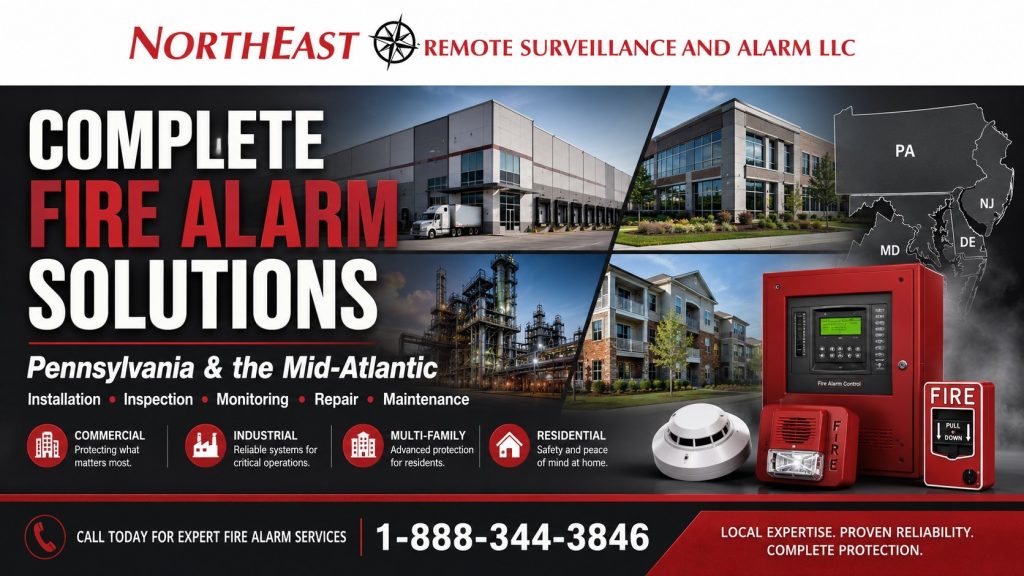
For commercial, industrial, warehouse, institutional, municipal, educational, healthcare, and other non-residential fire alarm projects, Northeast Remote Surveillance and Alarm, LLC (NERSA) supports qualifying projects through its fire alarm and life safety installation services in Pennsylvania and selected Mid-Atlantic markets. Confirm project scope and availability directly with NERSA.
This website is designed to help building owners and facility decision-makers better understand fire alarm systems, common service requirements, inspection considerations, monitoring options, upgrade decisions, and when professional fire alarm evaluation may be necessary.
Find Guidance for Your Building
Start with fire alarm planning by industry to organize your building information. For local project considerations, read the Allentown guide or Easton guide. Requirements still need confirmation for the individual property.
Before requesting proposals, prepare your panel model, building use, latest inspection report, and a list of known problems. Separate required corrections from optional improvements so each proposal addresses the same scope.
Understanding Fire Alarm Systems
A fire alarm system is designed to detect potentially dangerous conditions, alert building occupants, communicate system status, and support emergency response.
Depending on the building and application, a fire alarm system may include:
- Fire alarm control panels
- Smoke detectors
- Heat detectors
- Duct smoke detectors
- Manual pull stations
- Horns and strobes
- Speaker notification systems
- Sprinkler monitoring devices
- Supervisory devices
- Carbon monoxide detection
- Backup batteries
- Cellular or IP communicators
- Central station monitoring connections
The correct combination of devices depends on the building type, occupancy, applicable requirements, system design, and authority having jurisdiction.
Planning a Fire Alarm Installation
Fire alarm installation should begin with a review of the building rather than simply selecting individual devices.
Important considerations may include:
- Building size and layout
- Occupancy classification
- Number of floors
- Existing fire protection systems
- Detection requirements
- Audible and visual notification needs
- Accessibility requirements
- Sprinkler system monitoring
- Emergency communication needs
- Monitoring requirements
- Existing wiring and infrastructure
- Future expansion
- Inspection and maintenance requirements
Commercial and industrial facilities often require significantly more planning than smaller or simpler properties because the fire alarm system may need to coordinate with sprinklers, elevators, HVAC equipment, access-controlled doors, emergency communications, monitoring equipment, and other building systems.
Commercial Fire Alarm Systems
Commercial fire alarm systems protect occupants while also supporting the continuity and safety of business operations.
Commercial systems may be used in:
- Warehouses
- Manufacturing facilities
- Office buildings
- Retail properties
- Schools
- Healthcare facilities
- Municipal buildings
- Industrial facilities
- Distribution centers
- Multi-tenant buildings
- Hotels
- Institutional properties
- Mixed-use facilities
The appropriate system should be designed around the actual risks and operational requirements of the property.
Commercial building owners should also consider long-term maintenance, availability of replacement parts, expansion capability, monitoring communication paths, documentation, and future code-related improvements.
Fire Alarm Inspections and Testing
Routine inspection and testing help verify that a fire alarm system remains functional and that problems are identified before they become larger reliability issues.
Inspection and testing may involve:
- Fire alarm control panel review
- Smoke detector testing
- Heat detector testing
- Pull station testing
- Horn and strobe testing
- Speaker testing
- Battery testing
- Sprinkler supervisory signal testing
- Alarm communication testing
- Trouble signal verification
- Supervisory signal verification
- Documentation review
Inspection frequency and testing requirements vary depending on the system, occupancy, equipment, applicable standards, and requirements of the authority having jurisdiction.
Building owners and facility managers should maintain accurate service and inspection records so system history is available when repairs, upgrades, inspections, or future renovations are performed.
Fire Alarm Monitoring
Fire alarm monitoring provides a communication path between the protected property and a monitoring facility or other approved response pathway.
Modern monitoring may use:
- Cellular communicators
- IP-based communication
- Dual-path communication
- Legacy telephone communication on older systems
- Approved commercial fire alarm communicators
Communication technology has changed considerably over time. Older fire alarm panels may still rely on telephone-based transmission methods that are becoming increasingly difficult to support.
In some cases, the fire alarm panel itself remains serviceable while the communicator can be upgraded to a newer cellular or IP-based solution.
Fire Alarm Repair and Troubleshooting
Fire alarm systems can develop trouble conditions for many reasons.
Common problems may include:
- Failed batteries
- Damaged detectors
- Wiring faults
- Ground faults
- Communication failures
- Failed notification appliances
- Dirty smoke detectors
- Damaged pull stations
- Failed modules
- Corroded connections
- Power supply problems
- Aging control panels
- Discontinued replacement parts
A trouble condition does not always mean the entire fire alarm system needs to be replaced.
Professional troubleshooting can help determine whether the issue can be corrected through repair, component replacement, communicator upgrades, wiring repairs, programming changes, or larger system modernization.
Repair, Upgrade or Replace?
One of the most common questions building owners face is whether an older fire alarm system should be repaired, upgraded, or replaced.
Repair may make sense when:
- The control panel remains supported
- Replacement parts are available
- The problem is isolated
- Wiring remains in good condition
- The system still meets the property’s needs
An upgrade may make sense when:
- Communication technology is outdated
- Selected devices need replacement
- Notification coverage needs improvement
- Building renovations have changed system requirements
- Additional zones or devices are needed
- Existing infrastructure can still be reused
Replacement may become appropriate when:
- The panel is obsolete
- Replacement parts are unavailable
- Repeated failures are occurring
- The system cannot support required expansion
- Existing equipment is no longer practical to maintain
- Major renovations require extensive modification
A professional evaluation can help determine which approach makes the most sense for the property.
Fire Alarm Control Panel Upgrades
The fire alarm control panel is the central point of the system.
Older control panels may eventually become difficult to maintain because of discontinued components, limited programming capability, communication limitations, or lack of expansion capacity.
A control panel upgrade may provide:
- Improved diagnostics
- Better communication options
- Expanded device capacity
- Improved event history
- Modern programming capability
- Better serviceability
- Compatibility with newer detection devices
- Improved system documentation
In some projects, existing wiring or selected devices may be reusable. In others, a broader system replacement may be appropriate.
Smoke Detection
Smoke detection technology plays an important role in many fire alarm systems.
Commercial systems may use:
- Photoelectric smoke detectors
- Addressable smoke detectors
- Conventional smoke detectors
- Duct smoke detectors
- Specialized detection equipment
Detector placement, spacing, environment, accessibility, airflow, building conditions, and system compatibility all need to be considered.
Smoke detectors should also be maintained according to applicable requirements and manufacturer recommendations.
Heat Detection
Heat detectors may be used where smoke detection is not appropriate or where additional detection coverage is needed.
Common applications may include:
- Mechanical spaces
- Utility rooms
- Warehouses
- Industrial environments
- Storage spaces
- Areas subject to dust or airborne contaminants
Heat detectors may operate using fixed-temperature, rate-of-rise, or other detection methods depending on the device and application.
Notification Appliances
Notification appliances alert building occupants when the fire alarm system activates.
These devices may include:
- Horns
- Strobes
- Horn-strobes
- Speakers
- Speaker-strobes
- Bells
- Specialized visual notification devices
Proper notification design considers visibility, audibility, building layout, ambient noise levels, occupancy, accessibility requirements, and system power capacity.
Replacing notification appliances should not be treated as a simple cosmetic upgrade because device compatibility and electrical requirements must be considered.
Sprinkler System Monitoring
Many commercial fire alarm systems monitor portions of the building’s sprinkler system.
Examples may include:
- Waterflow switches
- Valve tamper switches
- Low-pressure conditions
- Fire pump signals
- Supervisory conditions
These signals help the fire alarm system report conditions affecting the building’s fire protection equipment.
Proper coordination between the fire alarm system and sprinkler system is particularly important in warehouses, industrial buildings, large commercial properties, and institutional facilities.
Carbon Monoxide Detection
Carbon monoxide detection may be required or recommended in certain occupancies and building environments.
Commercial carbon monoxide detection may differ from typical residential standalone alarms because detectors may be connected directly to a building fire alarm or life-safety system.
Applications can include properties with:
- Fuel-burning equipment
- Boilers
- Furnaces
- Commercial kitchens
- Parking garages
- Vehicle areas
- Generator rooms
- Other potential carbon monoxide sources
System requirements vary based on building type and applicable regulations.
Fire Alarm Communication Upgrades
Older commercial fire alarm systems sometimes depend on communication technologies that are becoming obsolete.
A communication upgrade may allow an otherwise functional fire alarm panel to continue operating while replacing the transmission method used for monitoring.
Possible upgrade paths may include:
- Cellular communication
- IP communication
- Dual-path communication
- Approved modern fire alarm communicators
Communication upgrades can be particularly useful when the existing panel and field devices remain in acceptable condition.
Preventive Fire Alarm Maintenance
Preventive maintenance can help reduce system failures, nuisance alarms, emergency service calls, and inspection deficiencies.
Maintenance may include:
- Battery replacement
- Detector cleaning
- Device replacement
- Wiring repair
- Connection tightening
- Communicator testing
- Panel troubleshooting
- Programming updates
- Documentation updates
- Replacement of damaged notification devices
Keeping accurate maintenance records also makes future troubleshooting and system planning easier.
Understanding Fire Alarm Codes and Standards
Fire alarm requirements can vary substantially between buildings and jurisdictions.
Factors affecting requirements may include:
- State regulations
- Local building codes
- Fire prevention codes
- Occupancy classification
- Building construction
- Property use
- Renovation scope
- Existing fire protection systems
- Authority having jurisdiction
NFPA 72 is widely used as a fire alarm and signaling reference, but it is only one part of the overall code and regulatory environment.
Building owners should avoid assuming that requirements in one municipality automatically apply in another.
Local permitting officials, fire officials, inspectors, design professionals, and qualified fire alarm contractors may all play a role in determining the requirements for a particular project.
Choosing a Fire Alarm Contractor
Fire alarm systems should be evaluated and serviced by organizations familiar with commercial life-safety systems and the requirements involved in maintaining them.
When evaluating a fire alarm contractor, consider:
- Commercial fire alarm experience
- Knowledge of applicable systems
- Troubleshooting capability
- Inspection experience
- Monitoring communication knowledge
- Upgrade and retrofit experience
- Access to replacement equipment
- Documentation practices
- Service capabilities
- Experience with the property’s building type
For larger commercial and industrial properties, it can also be helpful to work with a security and life-safety integrator capable of coordinating fire alarm systems with other building technologies where appropriate.
For commercial and industrial projects, Northeast Remote Surveillance and Alarm, LLC provides additional information about professional fire alarm and life safety installation services.
Frequently Asked Questions
How often should a fire alarm system be inspected?
Inspection and testing schedules depend on the system, occupancy, equipment, applicable requirements, and authority having jurisdiction. Commercial systems generally require recurring inspection and testing, but the exact schedule should be determined for the specific property.
Can an older fire alarm system be repaired?
Often, yes. The deciding factors typically include the condition of the control panel, availability of replacement parts, condition of the wiring, compatibility of existing devices, and the overall reliability of the system.
Does an old fire alarm panel always need to be replaced?
No. Some older systems remain serviceable for many years. Replacement becomes more appropriate when equipment is obsolete, parts are unavailable, repeated failures occur, or the system can no longer support the building’s needs.
Can the fire alarm communicator be upgraded without replacing the panel?
In many cases, yes. Older telephone-based communication may sometimes be replaced with an approved cellular, IP, or dual-path communicator while retaining the existing fire alarm control panel.
What causes a fire alarm trouble condition?
Possible causes include low batteries, wiring faults, communication failures, detector problems, ground faults, damaged devices, power supply problems, or failed modules.
Are commercial fire alarm systems different from residential smoke alarms?
Yes. Commercial fire alarm systems are typically integrated systems involving a control panel, initiating devices, notification appliances, communication equipment, power supplies, and building-specific programming.
Can existing fire alarm wiring be reused during an upgrade?
Sometimes. Existing wiring may be reusable depending on its condition, configuration, compatibility, applicable requirements, and the equipment being installed.
Do warehouses require special fire alarm planning?
Warehouses can present unique challenges because of ceiling height, storage configuration, sprinkler systems, ambient noise, large floor areas, loading areas, and changing storage arrangements.
Can a small commercial property use a professional fire alarm system?
Yes. Commercial fire alarm systems can be designed for properties ranging from small businesses and offices to large warehouses, manufacturing facilities, campuses, and multi-building operations.
Commercial Fire Alarm Project Resources
Fire Alarm Installers PA is intended to help property owners and facility managers understand the decisions involved in fire alarm installation, inspections, maintenance, troubleshooting, monitoring, and upgrades.
For commercial and industrial fire alarm design, installation, system upgrades, monitoring, inspection support, and life-safety projects, visit Northeast Remote Surveillance and Alarm, LLC’s Commercial Fire Alarm & Life Safety Installation resource.
You can also contact Northeast Remote Surveillance and Alarm, LLC at 1-888-344-3846 to discuss a commercial fire alarm or life-safety project.
Find the Right Authority in PA, NJ, DE and MD
Start with the property address, not the contractor’s mailing address. Ask which office reviews the work, which requirements apply to the building, and who witnesses acceptance. Keep written answers with the project records. A statewide resource is a starting point; it does not replace the reviewing authority’s decision for your property.
Pennsylvania: Use the Pennsylvania Uniform Construction Code resource to establish the enforcement route. Many municipalities administer the UCC locally; state responsibilities differ for opt-out municipalities and certain facilities. Confirm the current requirements and transition provisions for the project before relying on an older report or proposal.
New Jersey: Begin with the Division of Fire Safety codes and regulations. Ask the local enforcing agency how ongoing fire-code obligations relate to the construction work you propose. Identify responsibility for permits, inspections, and any system certification before signing a scope of work.
Delaware: The State Fire Marshal provides fire alarm plan-submittal guidance, including links for existing-system changes. Review the instructions that match your scope and confirm whether formal submission and acceptance testing apply. Check the licensed fire-protection company information when evaluating a provider.
Maryland: Consult the State Fire Prevention Commission and Maryland fire-code resources. Confirm the responsible state or local office and the requirements applicable to the property. Do not assume that a neighboring county uses the same review process.
Prepare a Useful Project Brief
A useful brief explains the problem in terms the owner, designer, installer, and monitoring provider can all understand. “Replace the fire alarm” is too vague to compare proposals. “Evaluate repeated communication faults, retain compatible equipment where practical, and document the approved repair or replacement scope” gives the team a clearer starting point.
Record the property address and use, operating hours, planned tenant changes, existing panel and communicator models, available drawings, latest inspection findings, and known service issues. Describe access restrictions, occupied areas, and work windows. Name the person who can authorize work and the person responsible for daily building operations.
Separate the work into required corrections, condition assessment, and optional improvements. Ask each bidder to explain exclusions and assumptions. This helps prevent a low initial price from hiding missing design, permits, interface testing, monitoring setup, access equipment, training, or closeout documents.
Compare Proposals Beyond the Equipment Price
Compare the same scope across proposals. Look for who handles design, plan submission, equipment compatibility, installation, programming, inspection, acceptance coordination, and correction of deficiencies. Ask whether the proposal includes work by other trades and how changes will be priced.
Review recurring costs separately from installation costs. Monitoring, communication service, scheduled testing, replacement parts, and after-hours support may have different terms. Confirm contract length, renewal terms, account ownership, cancellation arrangements, and which records you receive if you change providers. These are purchasing questions, not a reason to choose one technology for every building.
Ask how future service will work. Who can obtain replacement parts? Who can access configuration records? Which changes require a specialist or manufacturer-authorized provider? A product name alone does not answer those questions. Request a written explanation of support responsibilities before committing to the system.
Assign Responsibilities Before Work Begins
The owner or facilities lead should coordinate access, records, occupants, and project decisions. The responsible design professional defines the applicable design scope. The fire alarm contractor performs its agreed work and supplies records. The monitoring provider manages its agreed signal-handling role. The reviewing authority determines the approval and inspection steps within its jurisdiction.
Include IT when communications use a managed network. Discuss network changes, equipment power, outage reporting, and who receives service notices. Include the relevant trades when doors, HVAC, elevators, or suppression equipment are involved. Write down who installs each interface, who confirms the intended sequence, and who participates in testing.
Plan Work in an Occupied Building
Discuss the work sequence before equipment is taken out of service. Ask the responsible professionals to identify impairment procedures, required notifications, temporary measures, and restoration checks for the scope. Record who has authority to begin and end a work window and who will notify affected occupants and monitoring personnel.
Keep a daily handover record during phased work. It should identify completed areas, remaining work, open deficiencies, and the next planned visit. A building manager should not have to infer system status from a contractor’s departure. Resolve uncertainty with the responsible provider; do not bypass or disable equipment to make nuisance indications disappear.
What to Request at Handover
Build an organized record set rather than a folder of unrelated invoices. Ask for the documents appropriate to the approved work: drawings, equipment information, device identification, sequence of operations, test results, deficiency corrections, monitoring details, training records, and service contacts. Identify any outstanding approval or follow-up action explicitly.
Keep a readable copy where authorized staff can find it, with a controlled backup. Record who received training and which tasks that training covered. A new facilities manager should be able to identify the provider, locate the latest report, and understand what remains unresolved without reconstructing the project from email.
Reusable Owner Checklists
Before the site visit: gather plans and reports; photograph equipment labels where safely accessible; list recurring symptoms and when they happen; identify building changes; arrange access with the responsible staff. Do not open equipment or perform tests solely to prepare the brief.
Before accepting a proposal: confirm scope, exclusions, required approvals, provider qualifications, other-trade responsibilities, work windows, recurring charges, and required closeout documents. Ask how existing equipment will be evaluated before replacement.
Before closing the project: reconcile the agreed scope with the delivered work, review open deficiencies, receive applicable test and acceptance records, confirm monitoring contacts, and arrange owner training and the next required service activities.
Choose Your Next Step
For building-specific considerations, use our industry planning overview. If you are organizing local work, start with the Allentown or Easton guide, then confirm the authority responsible for the actual address.
For a commercial project discussion, visit NERSA’s fire alarm and life-safety resource. Bring the project brief and available reports so the team can discuss the scope and availability. This educational site does not issue approvals or certify that a building complies with applicable requirements.